
Pillar Guide
Sleep Support: A Practical Guide
A practical guide to sleep support covering timing, light, habits, stress, and environment — to help readers build conditions that make rest more likely.
Updated


Sleep is one of those things that tends to work best when you stop trying to force it. Most people can recognize the feeling of lying awake willing themselves to sleep and noticing that the effort itself seems to make rest harder to reach. This guide does not offer a perfect sleep formula — because no such formula exists. What it does offer is a practical look at the factors that may influence sleep quality: timing, light, what happens during the day, how the evening unfolds, the state of your nervous system, and the environment you sleep in. The aim is not a rigid prescription but a clearer understanding of how these things connect, so that you can identify what might be most worth adjusting in your own life. Small, consistent changes in the right areas tend to be more useful than an all-at-once overhaul.
What Healthy Sleep Support Means
Sleep support is not about achieving perfect sleep every night. It is about building conditions and patterns that make rest more likely to come — and more likely to feel restorative when it does. This is a meaningful distinction, because the pursuit of perfect, uninterrupted sleep on demand is one that few people sustain consistently, and chasing it too aggressively can sometimes make sleep harder rather than easier.
What characterizes healthy sleep varies more between people than is often assumed. Sleep duration, depth, and the number of times someone briefly wakes during the night can all fall within a wide range of normal. Age, lifestyle, stress levels, health status, and individual biology all influence what a good night looks like for a given person on a given night.
This guide takes a practical, non-prescriptive approach. Rather than offering a rigid checklist of rules to follow, it explores the factors that may influence sleep quality — timing, light, habits, stress, environment, and what happens in the hours before bed — and offers realistic ways to work with them. Some of these adjustments may make a noticeable difference for some people. Others may be less relevant to your particular situation. The goal is to help you understand the landscape so you can identify where small changes might be most useful for you.
It is also worth establishing early that occasional difficult nights are part of most people's experience. One poor night of sleep does not mean something is wrong, and the anxiety that sometimes follows — worry about not sleeping, or about what a bad night will mean for the next day — can itself become a factor that makes sleep harder. Approaching sleep with a degree of flexibility and patience tends to work better than treating each night as a performance to be evaluated.
Where this guide ends is as important as where it begins. If sleep difficulties are persistent, severe, significantly affecting daily life, or accompanied by symptoms that concern you, the appropriate response is evaluation by a qualified health professional, not more self-management strategies. That context is addressed in the final section of this guide.
Sleep Pressure and the Circadian Rhythm
Two broad processes are thought to influence when and how well we sleep. Understanding them in general terms is one of the more useful things someone can do to make sense of their own sleep patterns.
The first is sometimes called sleep pressure — a gradual buildup of a drive toward sleep that accumulates throughout waking hours. The longer you have been awake, the stronger this drive tends to become. It is one of the reasons that moderate tiredness in the evening feels different from the heavy fatigue of being awake for an unusually long stretch. When sleep pressure is allowed to build naturally through the day, it helps sleep arrive more readily at night.
The second process is the body's internal timing system, often described as the circadian rhythm or biological clock. This system operates on a roughly 24-hour cycle and coordinates a range of physiological functions — including when the body tends to feel alert, when it begins preparing for rest, and when it is most inclined to wake. The circadian rhythm is influenced by external cues, of which light is the most powerful. Regular patterns of light and darkness help anchor the internal clock to the external day, while irregular or disrupted patterns can shift it in ways that affect when sleep feels naturally available.
These two processes work together. Sleep pressure builds across the day and reaches a level that, combined with the circadian rhythm signaling that it is nighttime, creates the conditions under which sleep tends to begin. Disruptions to either process — napping too long late in the day, which releases some sleep pressure before bedtime; going to bed at substantially different times on different nights, which sends inconsistent timing signals — can make it harder to fall asleep or to sleep through the night.
Understanding these processes reframes some common sleep behaviors in a practical way. Trying to sleep before sufficient pressure has built, or at a time that conflicts with your body's internal timing, is likely to be more difficult than sleeping when both factors are aligned. Similarly, spending large amounts of time in bed awake — trying to force sleep, or resting during the day because of tiredness — can sometimes undermine the pressure buildup that supports sleep onset.
It is also worth noting that the timing of the internal clock varies between individuals. Some people naturally feel alert later in the evening and find it harder to wake early; others are alert and ready for sleep at earlier hours. These differences appear to have a biological component and are not simply a matter of discipline or preference. Practical strategies for sleep often work best when adapted to an individual's natural tendencies rather than applied as a universal prescription.
Recognizing Patterns That Disrupt Sleep
One of the more useful starting points for sleep support is observation — noticing which patterns in your daily life may be contributing to sleep difficulty, without immediately trying to change everything at once.
Some of the most common patterns that can affect sleep quality are less obvious than they might seem. An inconsistent sleep schedule — going to bed and waking at substantially different times across the week — can make it harder for the body's internal clock to establish a stable rhythm. Late stimulation, whether from absorbing content, emotionally activating conversations, or demanding mental work close to bedtime, can make it harder for the mind and nervous system to settle. Long naps or naps taken late in the afternoon can reduce the sleep pressure that helps sleep come at night.
Worry about sleep itself is another pattern worth recognizing. When sleep difficulty becomes a source of anxiety — when the bedroom starts to feel like a place of effort rather than rest, or when the thought of an approaching night produces apprehension — this can create a self-reinforcing cycle. Frequently checking the time during the night, calculating how many hours remain before the alarm, and mentally rehearsing how tired you will feel the next day are examples of behavior that can amplify rather than ease sleep-related worry.
Compensatory behaviors after a difficult night — sleeping much later than usual, going to bed considerably earlier the following evening, or dramatically cutting activity to conserve energy — can temporarily feel helpful but sometimes disrupt the processes that support sleep recovery.
Notice also that not every disrupting pattern is visible or dramatic. A background level of stress that has been normalized over time, subtle but regular evening stimulation that goes unnoticed, or a longstanding inconsistency in wake times can all contribute to less-than-restorative sleep without a clear, identifiable cause.
The purpose of this kind of observation is not self-blame. Sleep disruptions have many possible contributing factors, and most of them reflect the normal complexity of a full life rather than a personal failing. The aim is simply to develop a clearer picture of what may be influencing your sleep, which creates a more practical foundation for deciding what to adjust.
How Daytime Habits Affect Sleep
Sleep quality is shaped not just by what happens in the hour before bed, but by the broader pattern of the day. Some of the most practical support for sleep happens during waking hours, long before any deliberate wind-down begins.
One of the most consistent anchors for sleep is a regular wake time. Waking at approximately the same time each day — including days off, when the temptation to sleep in can be strongest — helps stabilize the body's internal timing. This consistency tends to be more useful than trying to control what time you fall asleep, which is ultimately harder to influence directly. The wake time anchors the clock; the sleep time tends to follow.
Daylight exposure in the morning and through the day is another factor that many people find meaningful. Light that reaches the eyes in the earlier part of the day provides a signal to the internal clock, helping to anchor the timing of alertness and sleep readiness. Spending some time outdoors or near a window in the first part of the day, where that is a realistic option, may support this process.
Physical activity is frequently mentioned in connection with sleep. Regular movement during the day — in whatever form is appropriate and sustainable — may contribute to physical tiredness that supports sleep onset. The relationship between vigorous activity in the evening and sleep quality varies between individuals; for some people it seems to have little effect, while others find that intense exercise close to bedtime makes settling harder. Noticing your own response is more useful than following a general rule.
Rest during the day also plays a role. Brief, well-timed naps help some people manage fatigue without affecting nighttime sleep. For others, napping reduces sleep pressure in ways that make falling asleep at night more difficult. Short naps taken earlier in the afternoon tend to have less impact on nighttime sleep than longer naps taken later in the day.
Daily structure itself — reasonably consistent mealtimes, transitions between different kinds of activity, and a rhythm to the day — can provide a background scaffolding that supports the body's timing systems. Sleep does not happen in isolation from the rest of what fills the day.
Light Exposure and Timing
Light is one of the most powerful external cues available to the body's internal clock. The timing, brightness, and character of light throughout the day may influence how the internal clock is set and, in turn, when the body feels inclined toward alertness versus sleep.
Morning light — particularly bright outdoor light in the earlier part of the day — sends a signal that helps anchor the internal clock to the time of day. Even a short period of outdoor exposure in the morning, done consistently, may help establish a clearer daily rhythm for some people. On overcast days, outdoor light still tends to be considerably brighter than most indoor environments.
As the day moves into evening, the natural transition from bright to dimmer, warmer light appears to support the body's shift toward sleep readiness. Many indoor environments maintain relatively bright lighting well into the evening, and screens emit a significant proportion of shorter-wavelength light that some research suggests may influence alertness signals.
It is worth being careful about how far this evidence is taken, however. Screens are one source of evening light among many, and overall brightness and timing are likely to matter at least as much as the type of light from a specific device. Treating screen use as an absolute cause of poor sleep, or demanding total screen avoidance as an evening rule, may be more stressful than helpful for many people. More realistic adjustments — reducing the overall brightness of your environment in the evening, switching to warmer lighting settings where available, and being mindful of stimulating content close to bedtime — may offer practical benefit without requiring a complete change to evening habits.
The relationship between light and sleep timing is also individual. Some people appear more sensitive to evening light than others, and the same lighting environment may have different effects on different people. Paying attention to whether changes in your evening lighting correspond with noticeable differences in how quickly or how well you sleep is a more practical approach than applying a rigid rule.
Caffeine, Meals, Alcohol, and Hydration
Several aspects of eating, drinking, and consumption patterns may influence sleep quality, and this is an area where individual variation is particularly significant. What substantially affects one person's sleep may have minimal effect on another's.
Caffeine is the most widely consumed substance with clear potential to affect sleep. It works in part by temporarily blocking signals associated with the buildup of sleep pressure, which can delay the onset of sleepiness and make falling asleep harder. The effects of caffeine persist in the body well after the original drink — the time it takes for caffeine to reduce to roughly half its initial level varies considerably between individuals, influenced by factors such as age, genetics, and other substances a person may be taking. For this reason, some people are sensitive to caffeine consumed in the early afternoon, while others seem less affected by coffee drunk later in the day. Rather than applying a universal cutoff time, it may be more useful to notice whether your own caffeine timing correlates with difficulty falling asleep, and to experiment with earlier timing if there appears to be a connection.
Meals and their timing can also influence sleep. Eating a heavy or rich meal close to bedtime can interfere with comfort and may affect how easily sleep comes for some people. On the other hand, going to bed quite hungry can also be disruptive for some. Most people find that a moderate meal completed with some gap before bed tends to be more neutral in its effects on sleep — though the right timing varies by individual.
Alcohol is worth addressing separately, because its relationship to sleep is commonly misunderstood. Alcohol may help some people feel sleepy or fall asleep more quickly, which can make it feel like a sleep aid. However, as the body processes alcohol through the night, sleep tends to become lighter and more fragmented. Someone who drinks in the evening may technically sleep through the night but wake feeling considerably less rested than they would have otherwise. This pattern tends to be more pronounced with larger amounts of alcohol, though individual sensitivity varies and even modest amounts can affect sleep quality for some people.
Hydration matters, but balance is also relevant. Drinking adequate fluids during the day supports general wellbeing and helps prevent dehydration from being a disruptive factor. At the same time, consuming large amounts of fluid close to bedtime increases the likelihood of nighttime waking. Maintaining good hydration during the day and tapering fluid intake in the period before bed is a reasonable general approach for many people.
As with other areas of sleep support, no single rule about timing or amounts applies equally to everyone. Understanding these relationships and then observing your own patterns tends to be more useful than following a fixed set of instructions.
Stress and Nervous-System Activation
The relationship between stress and sleep is one of the most commonly reported factors in sleep difficulty — and one of the most complex to address, precisely because it involves elements that are not always directly within our control.
When the nervous system is in a state of heightened activation — whether from a demanding day, unresolved worries, physical tension, or emotional strain — the physiological shift toward sleep becomes harder to reach. Sleep tends to arrive more naturally when the body and mind have had some opportunity to settle. Stress delays that settling. Some people notice this as an inability to switch off mentally when they lie down; others experience it as initially falling asleep without difficulty but waking in the early hours with a busy or anxious mind.
Worry about sleep itself can add an additional layer. When sleep becomes a source of apprehension, the approach of bedtime may itself become activating. The bedroom can shift from a place of rest to a place of effort and performance. This creates a self-reinforcing dynamic in which anxiety about not sleeping makes sleep harder to achieve, which in turn increases the anxiety around the next night.
Emotional load and life circumstances matter here too. Sustained sleep disruption during a period of significant stress, grief, relationship difficulty, or work pressure is not always a sign that something is fundamentally wrong with how a person sleeps. It may reflect an entirely normal response of a nervous system under considerable demand.
There are approaches some people find helpful for managing activation before sleep: reducing stimulating inputs in the evening, creating a consistent and calming transition into rest, setting aside some time earlier in the evening to note concerns or plan for the next day rather than leaving them unresolved, and including some form of gentle movement or physical activity during the day. None of these are guaranteed to produce a specific outcome, and they are not a substitute for addressing significant ongoing stress. But for many people, even a partial reduction in evening activation can be a meaningful step toward more consistent sleep.
Creating a Realistic Wind-Down Routine
A wind-down routine is a repeatable transition between the activity of the day and the stillness of sleep. Its value lies less in any specific set of activities and more in the signal it sends — that the demands of the day are ending and that rest is approaching. Over time, a consistent routine may help the body and mind begin shifting gears before you are actually in bed.
What makes a wind-down routine effective is that it is realistic enough to be followed consistently. An elaborate multi-step routine that requires a significant block of time, particular conditions, or specific equipment may work well under ideal circumstances but fail to hold up when the day has been unpredictable. A simpler routine that can be adapted to varying conditions is often more durable over time.
Some elements many people find useful include reducing the brightness and stimulation of the environment in the last hour or so before bed, finishing particularly engaging or emotionally activating tasks earlier in the evening where possible, and preparing for the next day so that nothing is left unresolved in a way that keeps the mind circling. Choosing activities in the final period before sleep that are calming rather than demanding also helps — not because relaxation is a requirement for sleep, but because lower activation tends to make the transition easier.
What counts as calming varies by person. Reading, gentle stretching, quiet music, light household tasks, or simply sitting without a screen may all serve this function for different individuals. The point is not the specific activity but the shift in pace and stimulation it represents.
It can also be useful to establish a consistent final signal — some small, repeatable action that marks the end of the wind-down and the beginning of sleep time. For some people this is making a drink, turning off lights in a particular order, or doing a brief and deliberate settling ritual. The content of this signal matters less than its regularity; repetition over time is what builds the associative value.
One common mistake is expecting a wind-down routine to be sufficient on its own if the rest of the day has been unusually activating. A wind-down works best as the final stage of a day that has already included some rhythm, movement, and genuine rest. Starting with a modest routine — even fifteen or twenty minutes — is more practical than designing an elaborate one that is difficult to sustain.
Supporting Sleep Through the Bedroom Environment
The physical environment of the bedroom plays a supporting role in sleep, though its importance is sometimes overstated. A comfortable, calm sleeping environment can help create conditions for rest, but it is rarely the single determining factor in sleep quality.
Temperature is one of the more consistently relevant variables. Most people sleep more comfortably in a cooler environment, and a bedroom that stays warm through the night may contribute to restless or fragmented sleep. The specific temperature that feels comfortable varies by individual. Opening a window, adjusting bedding weight, or using a fan to circulate air are practical adjustments that many people find useful.
Light and noise can affect sleep, particularly for lighter sleepers or those who live in bright or noisy environments. Even low levels of light entering the room — from streetlights, electronics, or an open door — may be disruptive for some people. Blackout curtains, an eye mask, or moving light-emitting devices are practical options. For noise, earplugs or consistent background sound may help mask intermittent sounds that interrupt sleep, though responses vary and some people find continuous sound more disruptive than silence.
The comfort of the mattress, pillow, and bedding matters, though these are highly individual and hard to generalize. Where physical discomfort is a consistent factor in waking or prevents settling in the first place, it is worth addressing. Elaborate purchases are unlikely to produce dramatic changes unless discomfort is a specific and ongoing issue.
Device placement in the bedroom is also worth considering. Notifications, light from screens, and the habit of checking a phone during the night can all be disruptive. Placing a device across the room, or outside the bedroom altogether where that is realistic, can reduce these interruptions without requiring the elimination of device use entirely.
What to Do After a Difficult Night
A poor night of sleep, while unpleasant, is something most people experience from time to time. How you respond in the hours and days that follow often influences whether sleep returns to its normal pattern quickly or whether difficulty extends.
One of the most common responses to a bad night is an attempt to compensate — sleeping much later the following morning, going to bed considerably earlier the next evening, or reducing activity significantly throughout the day to recover energy. While some gentle accommodation is reasonable, large compensatory shifts can disrupt the sleep-pressure and internal-timing signals that normally support recovery. Sleeping several hours later than usual may feel like rest but can delay sleep onset the following night and extend rather than shorten the disruption.
Another common response is heightened attention to sleep — monitoring energy levels throughout the day, feeling anxious about the night ahead, or making plans around the assumption that another difficult night is likely. This kind of vigilance can itself raise the background level of activation in a way that interferes with normal sleep when bedtime arrives.
A generally more supportive approach is to aim for a close-to-normal day after a difficult night. Getting up at around your usual time, getting some daylight, staying reasonably active in a way that suits your energy, and not dramatically restructuring the coming evening around the expectation of another poor night tends to support a faster return to normal patterns for most people.
Caffeine may help manage daytime tiredness after a difficult night, though using considerably more than usual or consuming it much later in the day than normal may make the following night harder. Moderate use, with timing consistent with your usual habit, tends to be a more neutral approach.
If difficult nights occur regularly rather than occasionally, or if recovery feels consistently slow, that is worth noting. Persistent sleep disruption is different from occasional difficulty, and it may indicate that additional evaluation or support would be useful.
When Persistent Sleep Problems Deserve Evaluation
This guide is an educational resource, not a clinical one. The perspectives and approaches it offers may be useful for common, mild, or occasional sleep challenges. They are not designed to address clinical sleep disorders, and self-management strategies have meaningful limits.
Some patterns of sleep difficulty suggest that professional evaluation would be appropriate rather than further self-management. Persistent difficulty falling asleep or staying asleep — lasting weeks or months rather than occasional nights — is worth discussing with a qualified health professional. Significant daytime impairment that is affecting concentration, mood, safety, work performance, relationships, or daily functioning is another indicator that deserves attention beyond everyday adjustments.
There are also patterns that point toward conditions requiring professional assessment specifically. Loud or irregular snoring, gasping, or breathing irregularities during sleep reported by a bed partner may warrant evaluation. Unusual or distressing behaviors during sleep — moving, speaking, or acting out dreams in ways that are confusing or concerning — are worth raising with a healthcare provider. Excessive daytime sleepiness that does not resolve with adequate nighttime sleep, or that feels out of proportion to circumstances, is also a reason to seek evaluation rather than adjusting lifestyle habits further.
Sleep concerns that affect safety — driving, operating equipment, or caring for others while significantly impaired — deserve prompt attention rather than a self-management response.
The appropriate first step for any of the above is a conversation with a primary care provider or, where available, a clinician with a focus on sleep. These professionals can assess what is present, consider contributing factors, and determine whether further evaluation or specific interventions are appropriate. This guide is not a substitute for that kind of evaluation, and none of its suggestions should be used to delay seeking care when these patterns are present.
Practical checklist
- Aim for a reasonably consistent wake time each day, including days off where possible.
- Get some daylight earlier in the day — even a short time outdoors may help anchor your body's internal timing.
- Notice whether your caffeine timing may be connected to difficulty falling asleep, and experiment with earlier timing if so.
- Establish a small, repeatable wind-down cue that signals the transition from the activity of the day toward rest.
- Allow some time before bed to step back from activating content, demanding tasks, or emotionally intense material.
- Check that your sleep environment is reasonably cool, dark, and comfortable — and make adjustments where you are able to.
- After a difficult night, try to maintain a close-to-normal day rather than making large compensatory changes that may affect the following night.
- If sleep difficulties are persistent, severe, or significantly affecting your daily functioning, consider speaking with a qualified health professional.
Frequently Asked Questions
How much sleep do adults typically need?
Sleep needs vary between individuals and can shift with age, health, and circumstances. While a commonly referenced range for adults is around seven to nine hours, some people function well with somewhat more or less. Rigid targets can be less useful than observing how you feel over time — whether you are able to stay reasonably alert during the day and whether you feel rested on a typical morning.
Can one bad night of sleep cause lasting harm?
A single night of poor sleep is unpleasant but is generally well tolerated. Performance and mood may be affected the following day, but most people recover as normal sleep returns. One pattern worth watching is the response to a difficult night — particularly heightened anxiety about the next night — which can sometimes extend difficulty beyond the original disruption.
Does going to bed earlier always help you sleep better?
Not necessarily. If sleep pressure has not built sufficiently, or if the timing conflicts with your body's internal rhythm, going to bed earlier can result in lying awake rather than sleeping. A consistent wake time is often more useful as a starting point, because it helps anchor the internal clock without reducing the sleep pressure that supports sleep onset.
How long before bed should I stop drinking caffeine?
This varies considerably between individuals. How quickly the body processes caffeine depends on a range of factors, and there is no single cutoff that applies equally to everyone. A practical approach is to notice whether your current caffeine timing seems to correlate with difficulty falling asleep, and to experiment with stopping earlier — observing over several days whether there is a meaningful difference.
Are screens always the main cause of poor sleep?
Screens can be a contributing factor, particularly through the light they emit and the stimulating content they often deliver in the evenings. However, they are rarely the sole cause of poor sleep, and complete screen avoidance is not always necessary or realistic. Reducing brightness, choosing calmer content in the evenings, and being mindful of overall stimulation levels may be more practical than an absolute rule.
When should sleep difficulty be professionally evaluated?
Sleep problems that are persistent, severe, or significantly affecting daily functioning — including concentration, mood, safety, work, or relationships — are worth discussing with a qualified health professional. Symptoms such as loud or irregular snoring, breathing changes during sleep, unusual nighttime behaviors, or daytime sleepiness that does not resolve with adequate rest are also worth raising with a healthcare provider.
Explore Related Sleep Topics
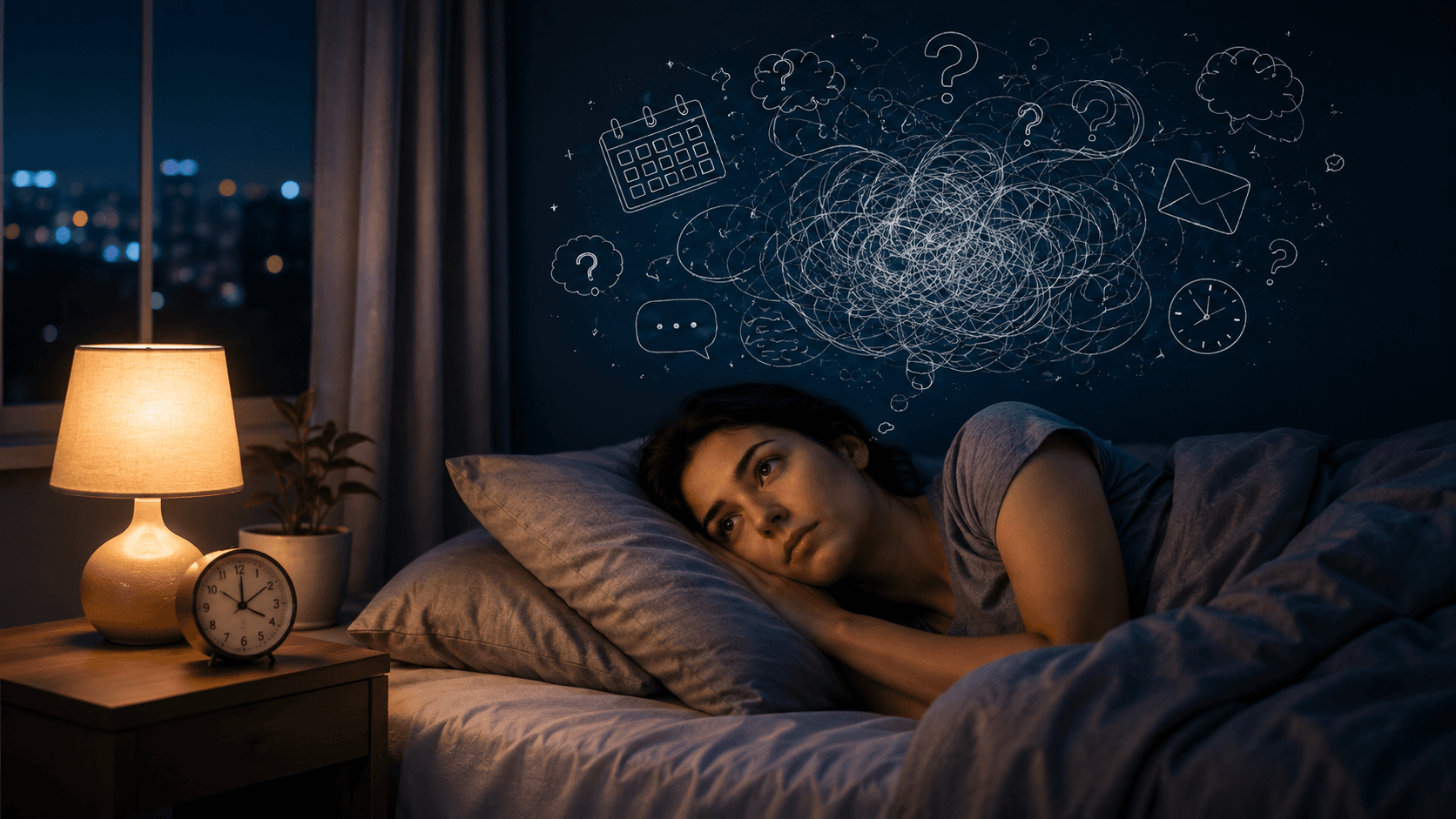
Racing Thoughts at Night: How Worry and Rumination Affect Sleep
Why do thoughts often feel louder when the day becomes quiet? Learn how worry and rumination may affect sleep, and explore gentle ways to create a calmer transition into rest.

The Internal Clock: How Your Circadian Rhythm Controls Sleep
Your body follows an internal rhythm that helps shape when you feel alert and when you begin to slow down. Learn how light, timing, and daily habits may support a steadier sleep-wake cycle.

Evening Light and Melatonin: Why Your Screen Habits Matter
Evening light can affect the body's transition toward sleep. Learn how screens, brightness, and late-night content may shape your rest — and how to create a softer landing into the night.

Caffeine and Sleep: How Timing Can Affect Your Night
Caffeine can affect sleep even when falling asleep does not feel difficult. Learn how timing, quantity, and individual sensitivity may shape the quality of your night.

The Stress-Sleep Cycle: Why Stress Can Keep You Awake
Stress can make it harder to rest, and a difficult night can make the next day feel even more demanding. Learn how the stress-sleep cycle works and what may help the body transition toward rest.