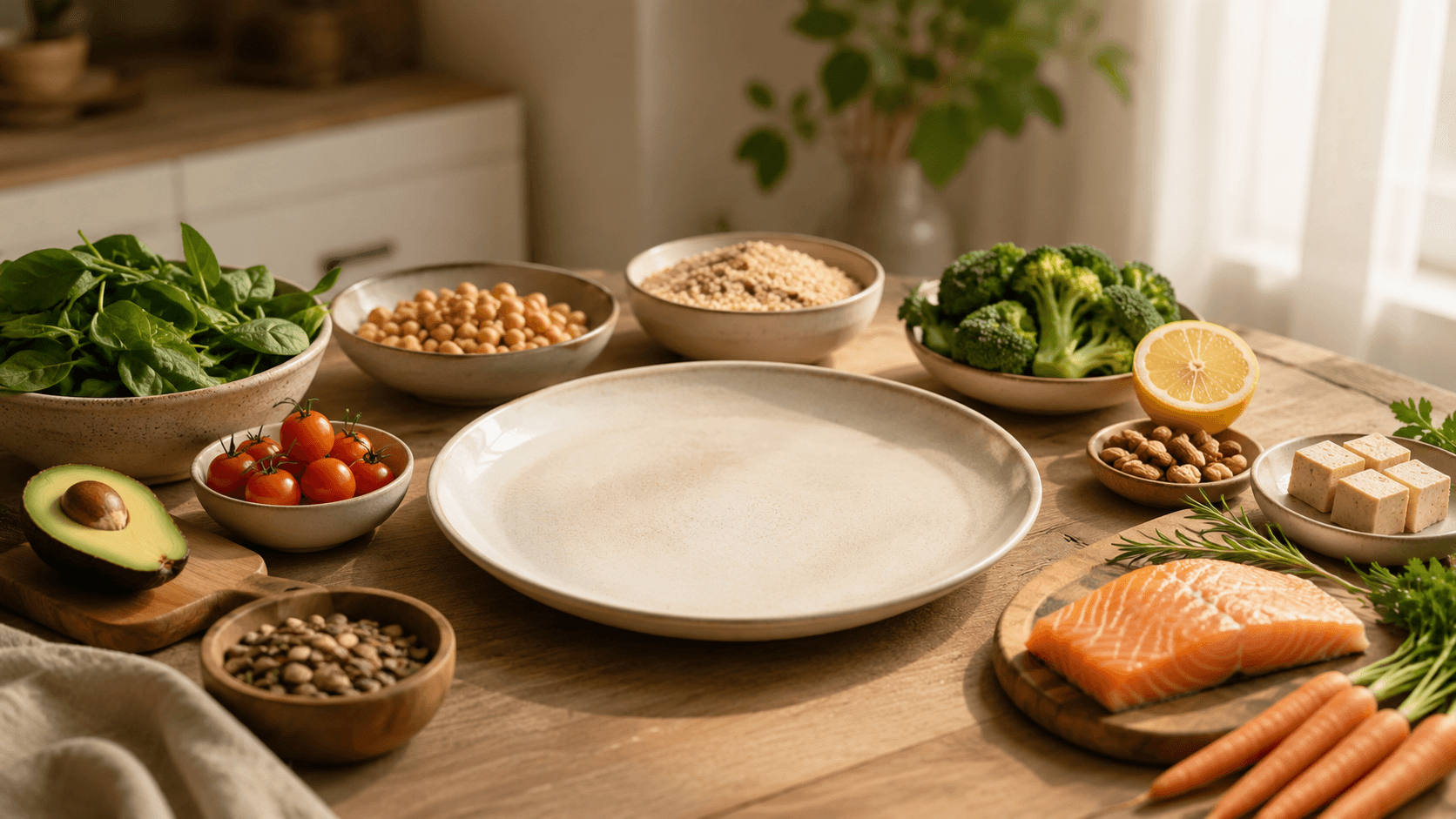
Pillar Guide
Nutrition Basics: A Practical Guide
A practical introduction to balanced eating, everyday food choices, and realistic nutrition habits that can fit different routines, cultures, and budgets.
Updated


This guide introduces core nutrition principles — what balanced eating means in practice, how different foods and food groups fit together, and why flexibility and variety tend to matter more than precision or rigid rules. Each section is a starting point that points toward a dedicated article where you can go deeper. Think of this as orientation, not prescription.
What Nutrition Basics Really Means
Nutrition basics is not about following a perfect set of rules or eating the same things every day. At its core, good nutrition is about patterns over time — the overall quality and variety of what you eat across days and weeks, rather than the nutritional profile of any single meal or snack.
One of the most helpful shifts when thinking about food is moving away from the idea that meals must be optimal to be worthwhile. A balanced eating pattern has room for convenience, cultural foods, social occasions, and personal preferences. It can include foods that carry limited nutritional value and still work alongside your overall wellbeing when the broader pattern is solid.
There is also no single eating style that works for every person. People have different food traditions, schedules, budgets, appetites, and health considerations, and useful nutrition guidance needs to account for that variety. A practical way to think about nutrition is that it is less about specific foods and more about a few broader habits: eating a variety of whole and minimally processed foods, including vegetables, fruits, legumes, grains, proteins, and healthy fats; not relying heavily on any single food category; and staying reasonably attuned to your own hunger and fullness over time.
This guide is designed as a starting point and a hub. It introduces core concepts and points you toward more detailed articles where individual topics are covered in greater depth. If you are newer to thinking about nutrition, the goal here is to offer orientation, not prescription. Many of the general principles that nutrition frameworks emphasize for everyday eating are accessible, flexible, and can fit into real life without requiring a dramatic overhaul of how you already eat.
Building a Balanced Eating Pattern
A balanced eating pattern generally refers to eating a variety of foods across the main food groups in proportions that leave you feeling reasonably well-nourished and energized. Rather than a fixed formula, it is better understood as a flexible framework that can shift based on your needs, preferences, and what is available to you.
Most broadly, a balanced approach to meals tends to include meaningful amounts of vegetables, a source of protein, a carbohydrate source, and some healthy fat — not in precise percentages, but in proportions that make the overall meal feel satisfying and varied. Over the course of a day or week, the goal is variety and consistency rather than perfection at any single meal.
Balance in eating also looks different across cultures, traditions, and individual circumstances. Mediterranean, Japanese, West African, and many other traditional food patterns can offer strong nutritional variety, even though they look quite different from each other on the plate. Balance is about what you eat over time, not about any particular cultural framework being superior or more correct.
If you would like a more detailed breakdown of how to structure individual meals — including practical approaches to proportioning vegetables, proteins, carbohydrates, and fats — the article on building a balanced plate goes deeper on those specifics and is a natural next read from this section.
Variety, Food Groups, and the Bigger Picture
Variety is one of the most consistently emphasized principles across nutrition frameworks. Eating a wide range of different foods — across and within food groups — can give your body access to a broader spectrum of nutrients, fiber sources, and other compounds that no single food alone can provide.
The main food categories most nutritional frameworks reference include vegetables and fruits, whole grains and starchy foods, protein sources (including both animal and plant-based options), dairy or calcium-rich alternatives, and sources of unsaturated fats such as nuts, seeds, and plant oils. No single food group is nutritionally complete on its own, and no single food group is so essential that it cannot be partially substituted by other foods in a thoughtful, varied diet.
What tends to matter more than strictly following a food-group checklist is the overall dietary pattern. Many general nutrition frameworks emphasize variety, generous vegetable and legume intake, moderate whole grains and protein, and limiting reliance on ultra-processed foods as part of a broadly balanced approach. Practically, these patterns show up across a wide range of cuisines and cultural traditions — not in one single prescribed menu.
One practical way to think about variety is to eat across different colors for vegetables and fruits, and across different textures and food types over the course of a week. This is not a rigid requirement but a useful orientation that naturally leads to more diverse intake without requiring you to track specific nutrients or study food composition tables. The goal is a pattern that is varied enough to be nutritionally broad and sustainable enough to maintain over time.
Protein, Fiber, and Unsaturated Fats
Protein, fiber, and unsaturated fats are three nutritional components that come up often in discussions of balanced eating — not because they are the only things that matter, but because many people find it useful to have a general sense of what role each plays and where to find them in everyday foods.
Protein is found in both animal sources — meat, poultry, fish, eggs, dairy — and plant sources including legumes, tofu, tempeh, edamame, and certain grains and nuts. Fiber is found in vegetables, fruits, legumes, whole grains, nuts, and seeds. Unsaturated fats appear in olive oil, avocados, nuts, seeds, and fatty fish. Eating a variety of these foods across the week is a practical way to include all three without needing to track or calculate anything.
Many nutrition frameworks treat protein, fiber, and unsaturated fats as useful anchors for thinking about meal variety and balance. Rather than treating them as precise targets to hit, a practical approach is to include varied sources of each across the week and let the overall pattern take shape from there.
The article on protein, fiber, and unsaturated fats goes into more depth on specific food sources and how these components fit into everyday meals — it is a useful next read if you would like more detail on any of them.
Eating Rhythms, Hunger, and Flexibility
How often and when you eat matters less than many popular nutrition conversations suggest — but it is not entirely irrelevant either. Eating at intervals that feel comfortable for your body, schedule, and appetite can help make it easier to make more intentional food choices and avoid arriving at meals very hungry.
Some people do well with three main meals a day. Others prefer smaller, more frequent eating occasions. Many people eat differently on weekdays than weekends, or during busy stretches compared to quieter ones. A practical way to think about eating rhythm is as a personal pattern that works for your life, not a universal schedule to follow precisely.
Staying attuned to your own hunger and fullness signals is one framing that many people find useful. Eating before you become very hungry and stopping when you feel comfortably satisfied is a principle that appears across a range of thoughtful approaches to food. Flexibility is also part of a realistic eating rhythm — the ability to adapt when circumstances change tends to be more useful than holding rigidly to an ideal schedule.
The article on the benefits of regular eating goes deeper on meal rhythm and what a consistent eating pattern can support — it is a natural next read if this section resonates with you.
Using Food Labels Without Losing the Bigger Picture
Packaged and processed foods are part of everyday life for most people, and being able to read a nutrition label can help you make more informed choices when shopping or comparing products. Label literacy is a practical skill — one that is most useful when applied with curiosity rather than anxiety.
A nutrition label describes a product, not your diet. A single food with a high sodium or sugar content does not automatically unbalance an overall eating pattern, just as an impressive nutrient profile does not make a meal nutritious on its own. Context and the overall pattern still matter more than the numbers on any single label.
For some people, paying close attention to every label can become a source of unnecessary stress, particularly for those who already find food choices fraught. The goal is to use labels as one informational tool among many, not as a continuous audit of every food choice.
The article on reading nutrition labels goes deeper on what specific label sections mean and how to use that information practically without becoming overly focused on individual numbers — it is a good next read if you want to develop that skill further.
Making Nutrition More Realistic During Busy Weeks
One of the most common friction points in everyday nutrition is time. During busy periods — demanding work schedules, stressful stretches, or just ordinary week-to-week pressure — it can feel harder to eat in a balanced way and easier to rely on whatever is most convenient.
The important thing to recognize is that nutrition during busy periods does not need to be perfect to be useful. Small, practical adjustments — having some nourishing options available, thinking a little ahead — can help support a more balanced overall pattern even during demanding stretches.
It is also worth accepting that some weeks will not allow for balanced eating in the usual sense. Nutrition is cumulative across weeks and months, not a single-day report card. The ability to return to your usual eating pattern after a demanding stretch is itself part of a sustainable approach to food. Treating a difficult week as a failure, rather than a normal part of a longer pattern, tends to make sustained good habits harder over time.
The article on healthy eating during busy weeks covers practical approaches in more depth — it is a natural next read if this challenge feels familiar.
Hydration and Everyday Beverages
Water is essential for virtually all body functions, and staying reasonably well-hydrated is one of the most consistently emphasized aspects of everyday health. Most people get hydration from a mix of plain water, other beverages, and the water content naturally present in many foods — particularly fruits and vegetables.
Individual hydration needs vary. For many healthy adults, thirst can serve as a useful everyday cue, and building a regular habit of drinking water throughout the day is a practical approach many people find helpful. Activity level, climate, and individual health status can all affect how much fluid feels right for you.
Not all beverages play the same role in an overall eating pattern. Plain water, unsweetened herbal teas, and low-fat dairy or fortified plant-based milks are often mentioned as practical everyday options. Beverages high in added sugar contribute calories with limited nutritional variety beyond the fluid itself, though they do not need to be entirely avoided to maintain a broadly balanced pattern.
Caffeine-containing drinks like coffee and tea, in moderate amounts, are generally considered compatible with a balanced diet for most people. Individual responses to caffeine vary, and some people find that high intake affects sleep or how they feel across the day.
If you have specific health considerations around fluid intake — including certain health conditions or medications — a healthcare professional is the appropriate person to consult about what works for your individual situation.
Culture, Budget, Access, and Enjoyment
Nutrition guidance that does not account for culture, food access, affordability, and personal preference is guidance that many people cannot realistically follow — or that asks them to abandon food traditions that carry real meaning.
Culture shapes what foods feel familiar, comforting, and satisfying. Traditional foods from across the world — from West African stews to Japanese rice-and-vegetable dishes, from Mexican bean-based meals to Mediterranean olive-oil cooking — reflect culinary traditions that can offer real variety. The idea that eating well requires replacing these traditions with a narrow set of approved foods is practically counterproductive for most people.
Budget and food access are equally real constraints. Whole, minimally processed foods are often presented as nutritional ideals, but fresh produce can be expensive, and access to quality grocery stores varies significantly by location. Practical nutrition guidance needs to work within the real constraints people face — which might mean relying on canned or frozen vegetables and fruits, which can be practical and accessible options, or using legumes and whole grains as affordable ways to add variety to everyday meals.
Enjoyment is also a legitimate and often underemphasized part of a sustainable relationship with food. Many people find that eating food they genuinely like, in ways that feel good to them, helps them maintain a more positive and consistent relationship with food over time. A broad, varied pattern you can sustain tends to be more useful in practice than one that is technically optimized but difficult to maintain.
Wherever you are starting from — whatever your background, budget, or food access looks like — there are generally ways to move toward more balanced eating that build on what you already have and value.
When Personalized Nutrition Guidance May Help
This guide, and the articles it links to, is educational in nature. It is designed to provide general orientation to nutrition principles that apply broadly across different situations and populations. It is not a substitute for personalized guidance from a qualified professional.
There are many circumstances in which working with a registered dietitian or another qualified healthcare professional is the most useful path. These include situations where diet is meaningfully connected to a health condition being managed, where you are navigating a difficult relationship with food or eating, or where you have specific dietary needs that go beyond general guidance — such as those related to particular health conditions, allergies, or intolerances.
General educational content cannot account for individual health history or circumstances that vary meaningfully from person to person. If general guidance does not seem to be working for you, or if specific health concerns feel clearly connected to how you eat, consulting with a registered dietitian is a reasonable and often worthwhile step.
In many places, registered dietitians are available through healthcare providers, community health centers, and telehealth services. If access or cost is a barrier, community programs and public health resources may also offer some degree of nutritional support.
The goal of this guide is to make general nutrition principles accessible and to reduce the overwhelm that often surrounds food choices — not to replace the individualized assessment that some situations genuinely require.
Practical checklist
- Consider adding a vegetable to one of your meals each day this week.
- Try including a protein source — animal or plant-based — with your main meals.
- Consider trying a whole grain version in one regular meal, such as brown rice, oats, or whole-grain bread.
- Notice when you reach for sweetened drinks by habit, and try choosing water for some of those occasions.
- See if you can include vegetables or fruits of two or three different colors across the week.
- Try including a source of unsaturated fat in some of your meals — olive oil, avocado, nuts, or seeds.
- Try to eat at intervals that feel comfortable for your body rather than going very long stretches without eating.
- Choose one meal this week to try a recipe from a cuisine or food tradition you do not usually eat from.
Frequently Asked Questions
What does balanced eating actually mean in practice?
Balanced eating refers to patterns over time rather than any single meal. It generally means eating a variety of foods across different food groups — vegetables, fruits, whole grains, proteins, and healthy fats — in proportions that leave you feeling reasonably well-nourished and energized. It does not require every meal to be nutritionally perfect, and it has room for cultural foods, convenience, and personal preferences.
Do I need to count calories or track macros to improve how I eat?
Not necessarily. Many people make meaningful improvements to their eating patterns without formally counting calories or tracking macronutrients. Developing a general sense of food variety, meal balance, and hunger and fullness signals tends to be more sustainable for most people than detailed tracking. Tracking can be useful in specific contexts — such as working toward a particular health goal with a dietitian — but it is not a requirement for eating well.
Are packaged and processed foods off-limits in a healthy diet?
No. Most people eat some packaged or processed foods regularly, and a healthy overall eating pattern can include them. Packaged foods vary widely in their ingredients and profiles — some can be practical and accessible choices, while others may be worth eating less often in the context of your overall pattern. What matters most is the overall balance and variety of your diet across the week, not whether any individual food carries a particular label. Context, frequency, and the overall eating pattern matter more than treating any individual food as automatically good or bad.
How much water should I drink each day?
Individual hydration needs vary based on body size, activity level, climate, and overall health, so there is no single amount that applies to everyone. For many healthy adults, thirst and building a regular habit of drinking water throughout the day can serve as useful everyday guides. Activity, climate, and certain health conditions or medications can all affect how much fluid feels right for you. If you have specific concerns around fluid intake, a healthcare professional is the best source of personalized guidance.
What if I have a limited food budget or limited access to fresh produce?
Canned and frozen vegetables and fruits can be practical and accessible options, and they are often significantly more affordable and longer-lasting than fresh. Legumes — lentils, beans, chickpeas — can provide protein and fiber as part of a varied diet and are often available at lower price points. Whole grains like oats, brown rice, and barley are also widely affordable. Practical nutrition is about working within your real constraints, not following an idealized shopping list. Small, consistent choices within your actual circumstances tend to matter more than occasional perfect meals.
When should I see a registered dietitian instead of relying on general nutrition guidance?
General educational content is a reasonable starting point for most people, but certain situations call for personalized professional guidance. These include managing a health condition where diet plays a significant role, addressing a difficult relationship with food or eating, dealing with specific dietary needs that go beyond general guidance, or navigating food allergies or sensitivities. A registered dietitian or another qualified healthcare professional can assess your individual circumstances, health history, and goals in ways that general content cannot.